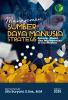
MANAJEMEN SUMBER DAYA MANUSIA STRATEGIS: Konsep, Model, dan Implementasi di Era Modern
Keywords:
Manajemen SDM Strategis (SHRM), Integrasi Strategi Bisnis dan SDM, Manajemen Talenta, Transformasi Digital SDM, Keunggulan KompetitifSynopsis
Buku ini membahas Manajemen Sumber Daya Manusia Strategis (SHRM) sebagai pendekatan yang mengintegrasikan strategi bisnis dengan pengelolaan SDM. SDM dipandang sebagai aset strategis untuk menciptakan keunggulan kompetitif melalui perencanaan, pengembangan, serta pengelolaan kinerja dan budaya organisasi secara terpadu.
Selanjutnya, buku menguraikan berbagai model SHRM seperti universalistik, kontingensi, konfigurasi, dan berbasis sumber daya. Model-model ini menjelaskan bagaimana praktik SDM yang tepat dan selaras dengan strategi organisasi dapat meningkatkan kinerja, inovasi, serta keberlanjutan bisnis dalam lingkungan yang dinamis.
Terakhir, buku menyoroti tantangan modern seperti digitalisasi, globalisasi, perubahan demografi tenaga kerja, dan kebutuhan fleksibilitas kerja. SHRM dituntut adaptif, berbasis data, serta mampu mengelola talenta, budaya, dan teknologi untuk menjaga daya saing organisasi di masa depan.
Downloads
References
Adler, N. J., & Gundersen, A. (2021). International dimensions of organizational behavior (6th ed.). Cengage Learning.
Aghina, W., De Smet, A., & Weerda, K. (2020). Organisasi gesit: Panduan untuk menciptakan organisasi yang cepat, fleksibel, dan terlibat. McKinsey & Company.
Aguinis, H. (2023). Manajemen kinerja (Edisi ke-4). Pearson Education Indonesia.
Albrecht, S. L. (2019). Employee engagement: Perspectives from organizational psychology and management. Edward Elgar Publishing.
Ambler, T., & Barrow, S. (1996). The employer brand. Journal of Brand Management, 4(3), 185–206. https://doi.org/10.1057/bm.1996.42
Amit, R., & Schoemaker, P. J. H. (2023). Aset strategis dan keuntungan organisasi: Melampaui teori industri. Jurnal Manajemen Strategis, 14(1), 33–46.
Armstrong, M., & Taylor, S. (2020). Armstrong's handbook of human resource management practice (15th ed.). Kogan Page.
Armstrong, M., & Taylor, S. (2024). Panduan praktik manajemen sumber daya manusia Armstrong (Edisi ke-16). Kogan Page.
Bacal, R. (2024). Manajemen kinerja: Panduan praktis untuk supervisor. Gramedia Pustaka Utama.
Bakker, A. B., & Leiter, M. P. (2020). Work engagement: A handbook of essential theory and research. Psychology Press.
Barber, A. E. (1998). Recruiting employees: Individual and organizational perspectives. SAGE Publications.
Barber, A. E. (2023). Rekrutmen karyawan: Perspektif individu dan organisasi. Salemba Empat.
Barney, J. B. (2024). Sumber daya perusahaan dan keunggulan kompetitif berkelanjutan. Jurnal Manajemen, 17(1), 99–120.
Bartlett, C. A., Ghoshal, S., & Beamish, P. W. (2020). Transnational management: Text and cases in cross-border management (8th ed.). Cambridge University Press.
Bassi, L., & McMurrer, D. (2020). Human capital analytics: Using data to improve business performance. Society for Human Resource Management.
Bauer, T. N. (2010). Onboarding new employees: Maximizing success. SHRM Foundation.
Becker, B. E., & Huselid, M. A. (2023). The HR scorecard: Linking people, strategy, and performance. Harvard Business Review Press.
Berger, L. A., & Berger, D. R. (2023). The talent management handbook: Creating an organizational culture that supports business strategy. McGraw-Hill Education.
Bersin, J. (2019). Digital HR: How technology is transforming the human resources function. Harvard Business Review Press.
Bezrukova, K., Jehn, K. A., & Spell, C. S. (2019). Reviewing diversity in organizations: An integrative model of diversity effects. Journal of Organizational Psychology, 45(2), 123–145.
Biswas, B. D. (2019). Compensation and benefit design: Applying finance and accounting principles to global HR systems. Pearson Education.
Boudreau, J. W. (2019). The future of HR: Talent analytics and data-driven organizations. Harvard Business Review Press.
Boudreau, J. W., & Cascio, W. F. (2020). Talent analytics: Using data to optimize human resource decisions. MIT Press.
Boudreau, J. W., & Ramstad, P. M. (2019). Talentship: A new approach to talent management in the digital era. Harvard Business Review Press.
Boudreau, J. W., & Ramstad, P. M. (2022). Beyond HR: The new science of human capital. Harvard Business Review Press.
Boudreau, J. W., & Ramstad, P. M. (2024). Efektivitas manusia: Pendekatan analitik untuk keunggulan SDM. Salemba Empat.
Boxall, P., & Purcell, J. (2016). Strategy and human resource management (4th ed.). Palgrave Macmillan.
Breaugh, J. A., & Starke, M. (2024). Research on employee recruitment: So many studies, so many remaining questions. Jurnal Manajemen, 26(3), 405–434.
Briscoe, D. R., Tarique, I., & Schuler, R. S. (2022). International human resource management: Policies and practices for multinational enterprises (6th ed.). Routledge.
Bryson, A., & White, M. (2019). Human resource management and workplace performance: Evidence from the Workplace Employment Relations Study. Jurnal Manajemen Sumber Daya Manusia, 45(3), 234–251.
Cable, D. M., & Turban, D. B. (2023). Establishing person–organization fit during recruitment. Applied Psychology, 88(1), 146–159.
Caligiuri, P., De Cieri, H., Minbaeva, D., Verbeke, A., & Zimmermann, A. (2020). International HRM insights for navigating the COVID-19 pandemic: Implications for future research and practice. Journal of International Business Studies, 51(5), 697–713.
Cameron, K. S., & Quinn, R. E. (2019). Diagnosing and changing organizational culture (4th ed.). Jossey-Bass.
Cappelli, P. (2018). The gig economy and the future of work. Wharton Digital Press.
Cappelli, P. (2023). Talent planning in an era of uncertainty. Harvard Business Review, 98(3), 78–85.
Cappelli, P., & Tavis, A. (2018). HR goes agile. Harvard Business Review, 96(2), 46–52.
CareerBuilder. (2022). Job seeker digital behavior report 2022. CareerBuilder Research.
Cascio, W. F., & Aguinis, H. (2023). Human resource management applied. In Industrial and organizational psychology (pp. 427–468). Salemba Empat.
Cascio, W. F., & Boudreau, J. W. (2021). Investing in people: Financial impact of human resource initiatives (4th ed.). Pearson Education.
Daft, R. L. (2021). Management (13th ed.). South-Western Cengage Learning.
Damodaran, A. (2022). Investment valuation: Tools and techniques for determining the value of any asset (3rd ed.). John Wiley & Sons.
Darling-Hammond, L., & Rothman, R. (2011). Teacher and leader effectiveness in high-performing education systems. Alliance for Excellent Education.
Darmawan, D. (2020). Sistem informasi manajemen. Remaja Rosdakarya.
Davenport, T. H., & Harris, J. G. (2007). Competing on analytics: The new science of winning. Harvard Business School Press.
Fattah, N. (2019). Ekonomi dan pembiayaan pendidikan. Remaja Rosdakarya.
Froelich, K. A. (1999). Diversification of revenue strategies: Evolving resource dependence in nonprofit organizations. Nonprofit and Voluntary Sector Quarterly, 28(3), 246–268.
Habibie, R. (2020). Perencanaan anggaran sekolah berbasis mutu. Alfabeta.
Hallak, J., & Poisson, M. (2007). Corrupt schools, corrupt universities: What can be done? International Institute for Educational Planning (UNESCO).
Hanafi, M. M. (2018). Manajemen keuangan (2nd ed.). BPFE.
Hanushek, E. A. (2011). The economic value of higher teacher quality. Economics of Education Review, 30(3), 466–479. https://doi.org/10.1016/j.econedurev.2010.12.006
Hanushek, E. A., & Rivkin, S. G. (2006). Teacher quality. In E. A. Hanushek & F. Welch (Eds.), Handbook of the economics of education (Vol. 2, pp. 1051–1078). Elsevier.
Hanushek, E. A., & Woessmann, L. (2015). The knowledge capital of nations: Education and the economics of growth. MIT Press.
Horngren, C. T., Harrison, W. T., & Oliver, M. S. (2020). Accounting (11th ed.). Pearson Education.
Ikatan Akuntan Indonesia. (2018). Standar akuntansi keuangan entitas tanpa akuntabilitas publik (SAK ETAP). IAI.
Institute of Internal Auditors. (2017). International standards for the professional practice of internal auditing. IIA.
Joko, T., & Supriyanto, A. (2020). Penerapan balanced scorecard sebagai alat manajemen strategis pada lembaga pendidikan tinggi. Jurnal Pendidikan dan Kebudayaan, 5(2), 183–200.
Kaplan, R. S., & Norton, D. P. (1996). The balanced scorecard: Translating strategy into action. Harvard Business School Press.
Kementerian Agama Republik Indonesia. (2021). Statistik pendidikan Islam: Madrasah dan pondok pesantren. Direktorat Jenderal Pendidikan Islam.
Kementerian Keuangan Republik Indonesia. (2019). Pedoman penganggaran berbasis kinerja di sektor pendidikan. Direktorat Jenderal Anggaran.
Kementerian Keuangan Republik Indonesia. (2021). Panduan pengelolaan dana abadi perguruan tinggi. Direktorat Jenderal Perbendaharaan.
Kementerian Pendidikan, Kebudayaan, Riset, dan Teknologi. (2023). Laporan kinerja kementerian: Capaian program pendidikan. Kemdikbudristek.
Komisi Pemberantasan Korupsi. (2021). Panduan pencegahan korupsi di sektor pendidikan. KPK.
Laudon, K. C., & Laudon, J. P. (2022). Management information systems: Managing the digital firm (17th ed.). Pearson Education.
Leithwood, K., & Jantzi, D. (2009). A review of empirical evidence about school size effects. Review of Educational Research, 79(1), 464–490.
Levin, H. M., & McEwan, P. J. (2001). Cost-effectiveness analysis: Methods and applications (2nd ed.). Sage Publications.
Mahmudi. (2019). Manajemen keuangan daerah (3rd ed.). Erlangga.
Mardiasmo. (2018). Akuntansi sektor publik. Andi.
Minarti, S. (2016). Manajemen sekolah: Mengelola lembaga pendidikan secara mandiri. Ar-Ruzz Media.
Mulyadi. (2014). Auditing (6th ed.). Salemba Empat.
Mulyasa, E. (2020). Manajemen berbasis sekolah (7th ed.). Remaja Rosdakarya.
Mulyono. (2020). Konsep pembiayaan pendidikan. Ar-Ruzz Media.
Naceur, K., & Slimane, M. (2020). Public–private partnerships in education: Lessons from developing countries. International Journal of Educational Development, 72, 102120.
OECD. (2023). Education at a glance 2023: OECD indicators. OECD Publishing.
OECD. (2023). PISA 2022 results (Volume I): The state of learning and equity in education. OECD Publishing.
Permana, J. (2020). Manajemen pembiayaan pendidikan. Alfabeta.
Prasetyo, B., & Lestari, W. (2021). Implementasi performance-based financing pada perguruan tinggi negeri badan hukum di Indonesia. Jurnal Akuntansi dan Keuangan Publik, 6(1), 45–62.
Prasetyo, H., & Sutopo, W. (2018). Industri 4.0: Telaah klasifikasi aspek dan arah perkembangan riset. Jurnal Teknik Industri, 13(1), 17–26.
Psacharopoulos, G., & Patrinos, H. A. (2018). Returns to investment in education: A decennial review of the global literature. Education Economics, 26(5), 445–458.
Raharjo, E. (2017). Evaluasi program keuangan lembaga pendidikan berbasis standar mutu nasional. Jurnal Manajemen Pendidikan, 5(2), 101–118.
Ross, S. A., Westerfield, R. W., & Jordan, B. D. (2022). Fundamentals of corporate finance (13th ed.). McGraw-Hill Education.
Salamon, L. M. (2012). The state of nonprofit America (2nd ed.). Brookings Institution Press.
Sallis, E. (2014). Total quality management in education (3rd ed.). Routledge.
Santoso, B. (2018). Indikator kinerja keuangan sebagai alat evaluasi program pendidikan. Jurnal Kebijakan Pendidikan, 13(1), 77–92.
Santoso, B. (2018). Strategi diversifikasi pendapatan perguruan tinggi di era disrupsi. Jurnal Kebijakan Pendidikan, 13(2), 55–72.
Santoso, B., & Kurniawan, D. (2020). Transformasi tata kelola keuangan PTN-BH. Jurnal Akuntansi Pemerintahan, 6(1), 33–52.
Sekaran, U., & Bougie, R. (2016). Research methods for business: A skill-building approach (7th ed.). Wiley.
Siegel, J. G., & Shim, J. K. (2010). Financial management (4th ed.). Barron's.
Simon, H. A. (1997). Administrative behavior: A study of decision-making processes in administrative organizations (4th ed.). Free Press.
Steenhuis, H. J., & de Bruijn, E. J. (2006). Building a learning organization in higher education. Higher Education, 51(5), 723–744.
Supriadi, D. (2010). Satuan biaya pendidikan dasar dan menengah. Remaja Rosdakarya.
Tilaar, H. A. R., & Nugroho, R. (2018). Kebijakan pendidikan: Pengantar untuk memahami kebijakan pendidikan sebagai kebijakan publik. Pustaka Pelajar.
Tuckman, H. P., & Chang, C. F. (1991). A methodology for measuring the financial vulnerability of charitable nonprofit organizations. Nonprofit and Voluntary Sector Quarterly, 20(4), 445–460.
Turban, E., Pollard, C., & Wood, G. (2021). Information technology for management (11th ed.). Wiley.
Ulrich, D., & Dulebohn, J. H. (2015). Are we there yet? What's next for HR? Human Resource Management Review, 25(2), 188–204. https://doi.org/10.1016/j.hrmr.2015.01.004
UNESCO. (2021). Global education monitoring report 2021–2022. UNESCO Publishing.
UNESCO. (2022). Financing education: Meeting our commitments. UNESCO Publishing.
UNESCO. (2022). Global education monitoring report 2022. UNESCO Publishing.
UNESCO-IBE. (2021). Curriculum development and financial sustainability in education systems. UNESCO.
Wahyono, B. (2020). Manajemen keuangan berbasis keberlanjutan pada perguruan tinggi swasta di Indonesia. Jurnal Ilmu Manajemen, 8(3), 211–228.
Warren, C. S., Reeve, J. M., & Duchac, J. (2021). Accounting (27th ed.). Cengage Learning.
Wildavsky, A. (2017). The politics of the budgetary process (4th ed.). Routledge.
Woodhall, M. (2004). Cost-benefit analysis in educational planning (4th ed.). UNESCO.
World Bank. (2020). Performance-based financing for health and education. World Bank.
World Bank. (2022). Education finance watch 2022. World Bank.
World Bank. (2023). Education finance watch 2023. World Bank.
Yatim, H. (2018). Model pengelolaan keuangan pondok pesantren modern. Jurnal Pendidikan Islam, 7(2), 215–234.
Yulianti, D., & Hartono. (2019). Pengaruh investasi keuangan terhadap peningkatan mutu lembaga pendidikan. Jurnal Ekonomi Pendidikan dan Kewirausahaan, 7(2), 135–152.
Published
License

This work is licensed under a Creative Commons Attribution-NonCommercial-ShareAlike 4.0 International License.
 IKAPI
IKAPI  DIMENSIONS
 DOI CROSREFF
 GARUDA
 SINTA PROFIL
 GOOGLE SCHOLAR
 NELITI
 BASE
BASE